
The Science of Sweating: Why Post-Workout Sauna Use Changes Your Recovery Game
Most people treat the sauna like a bonus.
A nice thing to do after the gym if you have time. A warm room to relax in before heading home. Maybe a perk that comes with the membership but never really gets used.
That framing is costing you results.
The sauna is not a luxury add-on. It is not the thing you do after recovery. It is where recovery begins. And if you are consistently doing the work in the gym, lifting heavy, training hard, showing up, but skipping the sauna on your way out, you are completing only half the equation.
The gains you are working for? They are waiting in the other half.
Why the Workout Is Only Part of the Work
Here is what the fitness industry rarely talks about. The workout is the stimulus. Not the result.
You go in. You lift heavy. You put the body under stress, break down muscle fiber, and deplete your glycogen stores. Then you leave. That is the input.
The output comes later. More muscle, lower body fat, better performance, faster recovery. It happens while you sleep. While you eat. While your body rebuilds what you just broke down.
Muscle protein synthesis (MPS) is the process responsible for that rebuilding. And here is the thing: MPS does not happen optimally when your body is still in a stressed, inflamed, sympathetic-dominant state. It happens when conditions are right. When inflammation is managed. When your nervous system has signaled that the threat is over and repair can begin.
That signal? Heat therapy helps trigger it.
What Actually Happens to Your Body in the Sauna
When you step into a sauna after training, your core temperature rises. That is the obvious part. But the cascade of physiological responses underneath is anything but simple.
Your blood vessels dilate. Circulation to muscle tissue increases dramatically, sometimes as much as 50 to 70 percent above resting rates. Nutrients flow in. Metabolic waste, the byproducts of heavy training, flows out. The mechanical efficiency of recovery improves immediately.
Your body produces heat shock proteins (HSPs). This is where the science gets genuinely fascinating. Heat shock proteins are molecular chaperones. Their job is to repair damaged proteins and prevent further cell damage. Research published in the Journal of Physiology shows that HSP production is significantly elevated after heat exposure, directly supporting muscle fiber repair after exercise-induced micro-tears.
Your cortisol drops. Training elevates cortisol. That is normal and necessary as part of the stress-adaptation cycle. But cortisol that stays elevated for hours post-workout actively works against muscle repair. Heat therapy has been shown to activate parasympathetic nervous system dominance, shifting your body out of fight-or-flight and into rest-and-repair mode. That shift is not psychological. It is measurable.
Growth hormone surges. This one surprises most people. A study published in Clinical Endocrinology found that two 20-minute sauna sessions, separated by a 30-minute cooling period, increased growth hormone levels by up to 200 to 300 percent. Growth hormone is the primary driver of tissue repair and muscle adaptation after training.
The Numbers Behind the Heat
The research here is not thin. It is two decades deep.
A landmark Finnish population study tracking over 2,300 men found that regular sauna users had significantly lower rates of cardiovascular disease, all-cause mortality, and systemic inflammation compared to infrequent users. Four to seven sessions per week reduced cardiovascular death risk by 50 percent versus once-weekly use.
For athletes specifically, a 2006 review in the International Journal of Circumpolar Health (Kukkonen-Harjula and Kauppinen) confirmed that repeated sauna exposure improves cardiovascular function, reduces inflammation markers, and enhances overall recovery capacity. All outcomes that directly translate to better gym performance over time.
The mechanism is adaptation. Sauna use trains your cardiovascular and thermoregulatory systems the same way lifting trains your muscles. You stress the system. It adapts. It becomes more efficient.
Three sessions a week is all it takes to start seeing measurable changes. Not three hours. Fifteen to twenty minutes, three times a week, right after your workout.
Sauna vs. Everything Else: An Honest Comparison
You have probably heard the recovery conversation before. Ice baths. Compression boots. Massage guns. Foam rolling. Stretching protocols. They all get cycled in and out of the fitness conversation like trends.
Here is the honest breakdown.
Ice baths (cold water immersion): Effective for reducing acute soreness and numbing inflammation in the short term. But a growing body of research, including a significant 2012 study in the Journal of Physiology, shows that cold water immersion post-workout can actually blunt the anabolic signaling that triggers muscle adaptation. You feel better faster, but you may be interrupting the very process you trained to start. Cold is better saved for injury management, not post-training recovery.
Compression boots and NormaTec: They move fluid. They increase lymphatic circulation. Useful, passive, and not adaptive. Your body does not become better at recovery because of them. It just gets helped in the moment.
Foam rolling and massage: Valuable for mechanical tension release and improving range of motion. The effects are real but localized and temporary. Massage does not trigger heat shock proteins. It does not elevate growth hormone. It does not retrain your cardiovascular response to stress.
Sauna: Does something categorically different. It triggers an adaptive response at the cellular level. Not just symptom management. Actual physiological adaptation. Your body gets better at recovering, not just recovered.
That distinction matters enormously over a training career measured in years, not weeks.
The Cortisol Problem Nobody Talks About
Training is a stressor. That is not a flaw. That is the point.
When you lift, your sympathetic nervous system activates. Cortisol rises slightly. Your body enters a brief catabolic state to mobilize fuel and manage the physical stress. All of that is normal and necessary.
The problem is what happens after you leave the gym.
For most people, the workout ends and the stress does not. You rush back to work. You sit in traffic. You answer emails. You handle whatever the afternoon brings. And because your cortisol was already elevated from training, it stacks on top of life stress and stays elevated for hours.
Elevated cortisol is your body's signal to prioritize threat management over tissue repair. Muscle rebuilding gets deprioritized. Inflammation persists. Sleep quality suffers. And the gains you trained for that morning sit waiting in a queue that never quite gets processed.
The sauna interrupts that cycle. Fifteen to twenty minutes of heat exposure after training gives your nervous system a clear off-ramp. The parasympathetic system activates. Heart rate steadies. Cortisol falls. Your body gets the signal: the stress is over. Begin repair.
At Broadway Gym, we see this play out in real time. Members who use the sauna consistently after training report better sleep, less day-after soreness, and more sustained energy throughout the week. That is not anecdote. It is physiology doing exactly what the research says it will.
How to Use the Sauna for Maximum Recovery
The sauna is not complicated. But there is a right way to use it, especially in the context of post-workout recovery.
Timing: Get in within 10 to 20 minutes of finishing your workout. You want to catch the tail end of your elevated body temperature and transition into the sauna before you fully cool down.
Duration: 15 to 20 minutes per session is the evidence-backed sweet spot. Long enough to trigger HSP production and parasympathetic activation. Short enough to avoid excessive fluid loss or unnecessary cardiovascular strain. If you are new to sauna use, start at 10 minutes and build gradually.
Hydration: Drink water before, during if comfortable, and after. You will lose fluid. Replenish it. A rough guide is 500ml before your session and 500ml after on training days.
Temperature: A traditional Finnish sauna runs between 80 and 100 degrees Celsius. Infrared saunas operate lower, typically 50 to 60 degrees, but penetrate tissue more deeply. Both produce meaningful recovery benefits. The key variable is consistency, not extreme heat.
Frequency: Three post-workout sauna sessions per week is enough to produce measurable adaptation. If you train more, use it more. The diminishing returns do not kick in at realistic training volumes.
What not to do: Skip the sauna when you feel sick, have an active injury producing acute inflammation, or have consumed alcohol. And if you have hypertension or a cardiovascular condition, clear it with your doctor first. Heat therapy is often beneficial for heart health, but individual circumstances vary.
Broadway's Perspective: One thing we notice at Broadway Gym is that the members who use the sauna most consistently are rarely the ones with the flashiest programs. They are the ones who have been training for years and still look forward to it. Recovery is not glamorous. But it is the reason some people keep progressing while others keep plateauing.
What This Looks Like as a Complete System
Most gyms make you choose: get the workout infrastructure, or get the recovery experience.
You can drive across town after training to access a sauna. You can book a massage separately. You can piece together a recovery system from multiple sources, multiple memberships, multiple appointments. Some people do that. Most people do not, because friction kills habits.
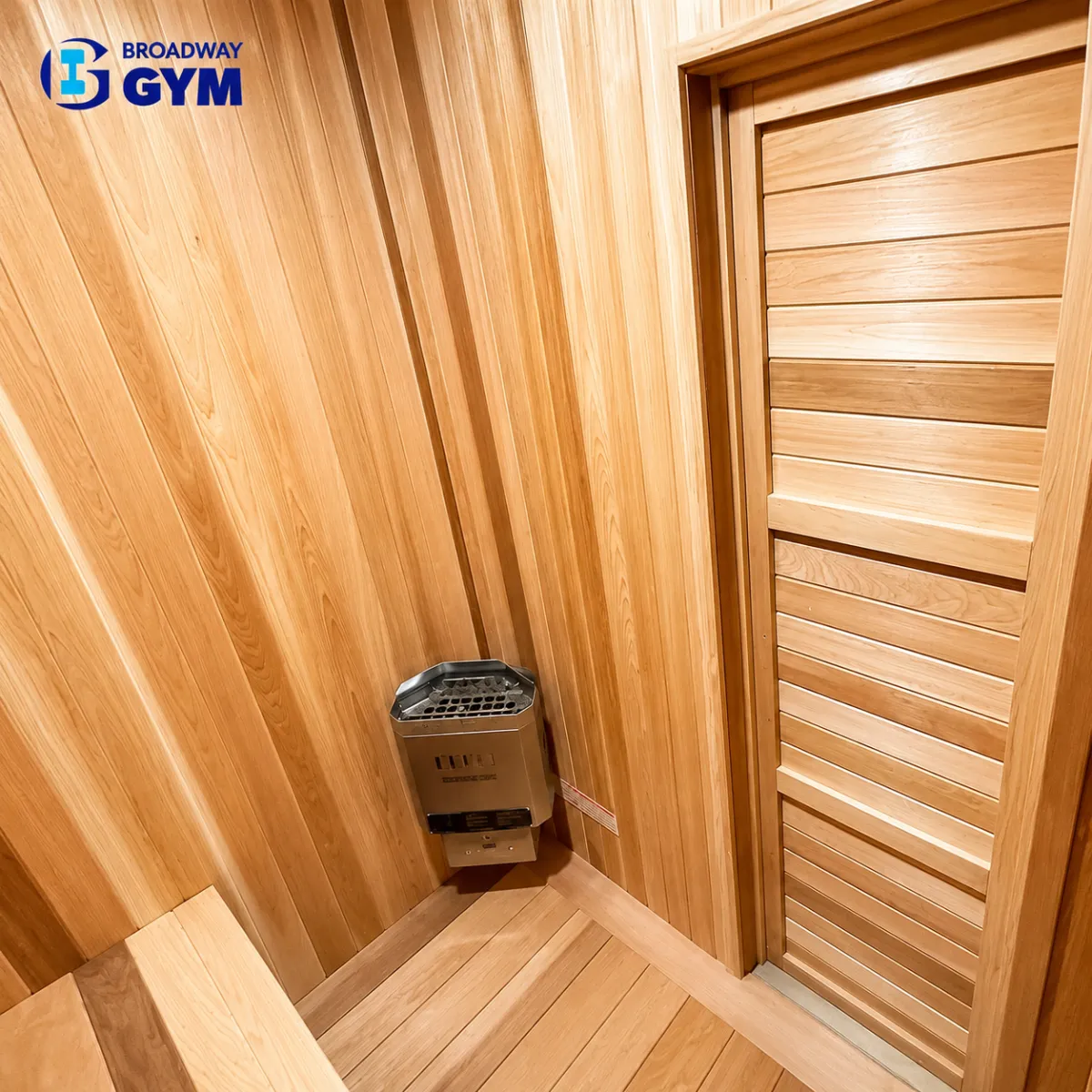
Broadway Gym is built differently. The sauna is included in every membership. No separate fee. No time limit. No booking required. You finish your lift, walk 30 feet, and step into a recovery environment that your training just made necessary.
That frictionless design is not an accident. It is based on something we have learned from watching members over years: when recovery is easy, people do it. When it requires effort, they skip it. Not because they are lazy. Because life is full and willpower has limits. The recovery system you actually use is infinitely more valuable than the one that exists somewhere across town.
The sauna at Broadway is not a perk. It is infrastructure.
30 Days of Sauna After Every Workout: What to Expect
For members who start using the sauna consistently post-workout, here is a realistic progression.
Days 1 to 7: The most immediate response is sleep. Heat therapy's effect on core temperature regulation and parasympathetic activation typically improves deep sleep quality within the first week. You may notice you fall asleep faster and wake up less stiff.
Days 8 to 14: Day-after soreness begins to decrease noticeably. Post-workout DOMS (delayed onset muscle soreness) typically peaks around 24 to 48 hours after training. With consistent sauna use, this window shortens. You recover faster and are ready to train again sooner.
Days 15 to 21: Energy levels stabilize. The cortisol reduction and parasympathetic activation from regular sauna use has a cumulative effect on baseline stress hormones. Many members report feeling less fatigued through the afternoon on training days.
Days 22 to 30: Performance markers start to move. You are recovering faster, sleeping better, and training with less accumulated fatigue. Progressive overload becomes easier because you are not carrying the residual soreness from three sessions ago into your current one.
This is not a supplement stack. It is not a dramatic intervention. It is 15 to 20 minutes of heat, applied consistently, letting your body do what it was already designed to do.
Try the Full System Free for 14 Days
If you have been training hard but feel like you are spinning your wheels, making the effort but not seeing the progress, showing up but not recovering, the missing piece may be simpler than you think.
Broadway Gym's 14-Day VIP Pass gives you full access to everything: the gym floor, the sauna, the hydromassage lounge, and the complete recovery suite. Use the sauna the way it was designed to be used. Not as an afterthought, but as the second half of every workout.
Feel what a complete training system actually feels like.
Frequently Asked Questions
How long should I spend in the sauna after working out?
15 to 20 minutes is the evidence-based sweet spot. This is long enough to trigger heat shock protein production and shift your nervous system toward parasympathetic recovery, without excessive fluid loss. If you are new to sauna use, start at 10 minutes and work up gradually over two to three weeks.
Can using a sauna actually help me build more muscle?
Yes, indirectly but meaningfully. Sauna use does not replace training stimulus or nutrition. But it optimizes the recovery environment where muscle adaptation happens. By increasing blood flow to muscle tissue, triggering heat shock protein production, reducing inflammation, and elevating growth hormone, post-workout sauna use creates better conditions for muscle protein synthesis. The training does the work. The sauna helps your body process it.
How is the sauna different from an ice bath for recovery?
They work through opposite mechanisms and produce different outcomes. Ice baths reduce inflammation and soreness in the short term but can blunt the anabolic signaling that drives long-term muscle adaptation. Sauna use enhances circulation, triggers heat shock proteins, and improves hormonal conditions for recovery without interfering with training adaptation. For most people focused on long-term strength and muscle development, sauna is the more appropriate post-workout choice.
Is it safe to use the sauna every day?
For most healthy adults, yes, especially at 15 to 20-minute sessions. The Finnish population data includes people who sauna four to seven times per week with significant health benefits and no adverse effects at those durations. The key variables are hydration, temperature, and pre-existing health conditions. If you have cardiovascular disease, hypertension, or other conditions, speak with your doctor before making sauna use a daily habit.
What if I don't have time for the sauna after every workout?
Even two or three sessions per week produces measurable recovery benefits. Consistency matters more than frequency. A reliable two-session-per-week habit for 12 months will outperform a sporadic every-day habit that falls apart after six weeks.